Lenten Reflection (2026)
Don't feed the monkeys

The other day, I was walking through Owl’s Head Park when I came across a sign that said “Don’t feed the squirrels” with the drawing of a hand throwing food at the aforementioned animal crossed over by an oppressive red line; because the government is inefficient to the end, the sign also had a separate, but identical, warning not to feed the birds. I was irked by this sign, not least of all because it basically criminalized the Pigeon Lady from Home Alone 2 (though perhaps the rules at Central Park are laxer than the ones at Owl’s Head). But, more importantly: after all we’ve done to the animals, can’t we at least give back with some free food?
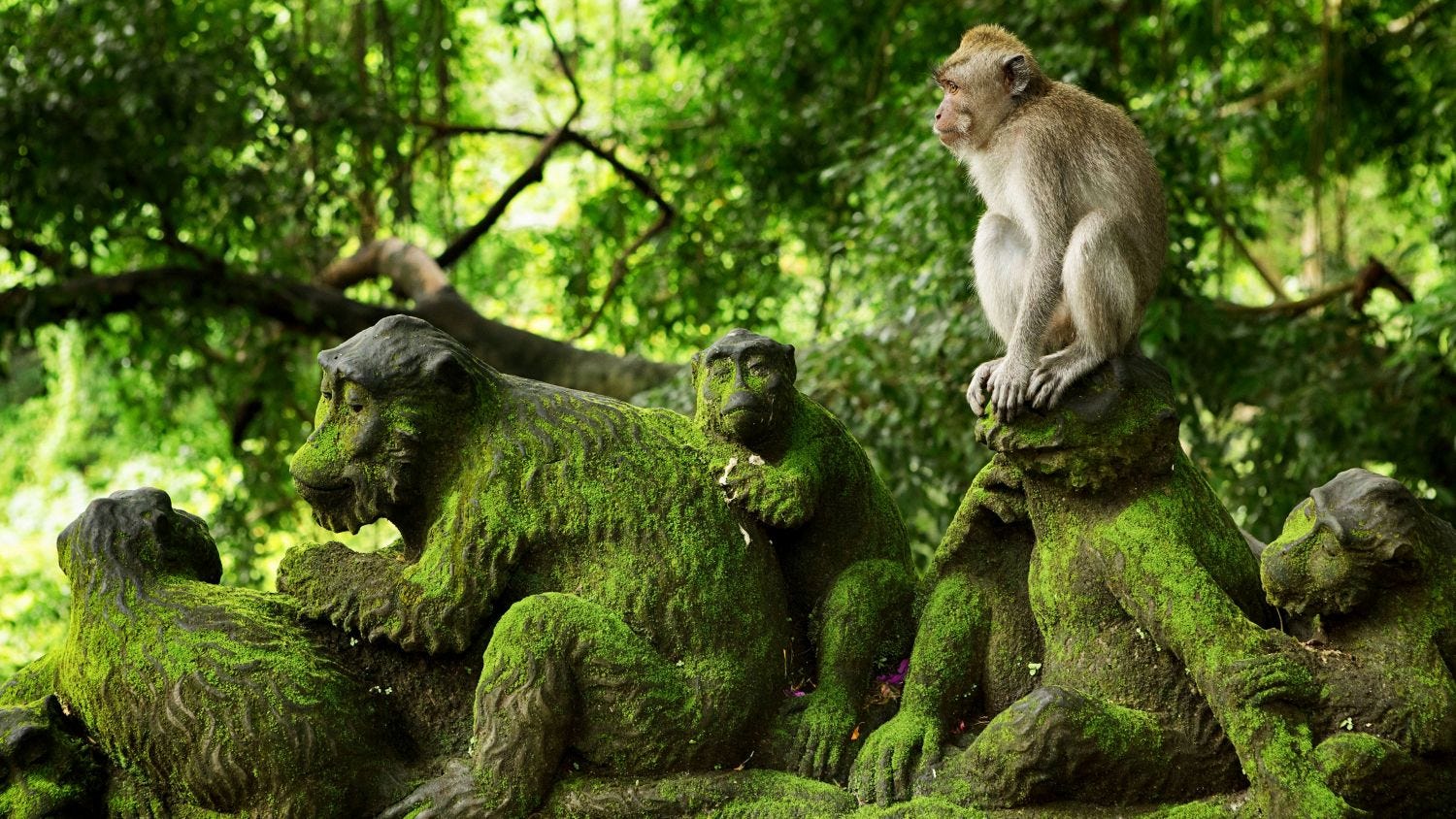
I was reminded, however, of a similar warning I received over ten years ago, when, enabled by the indecent salary of a job in banking, I traveled the world. This included a gorgeous trip to South Africa, during which, at some point, I remember being in a car traveling down a road at whose edges monkeys were congregating and doing monkey stuff. These particular macaques were very cute, but someone in the car who spoke for the South African government (I’m assuming, though maybe it was just some rando) told us: “Don’t feed the monkeys.” This person might’ve sensed no one was willing to take that seriously—again, the monkeys were very cute—so they followed up with: “DO NOT FEED THE MONKEYS. If you do, they get used to human food and become aggressive, and then we have to shoot them.” Jeez.
When I got home from that walk at Owl’s Head, I Googled it and confirmed that this was not just a violent, made-up memory from a long-ago trip, but a real problem. The wording from the South African National Parks website is so striking, in fact, that it is worth reproducing here (emphasis theirs):
Monkeys, baboons and bushbuck can be entertaining for young and old, BUT PLEASE DO NOT FEED THEM. Remember that by feeding them, you are signing their death warrant, as they become aggressive and may have to be destroyed. By feeding these animals you do not only aggravate the situation but you also make these animals lazy and they become dependant on this food supply.
Ok, GOT IT, don’t feed the monkeys. Puts Pigeon Lady in a whole new light, doesn’t it? She was signing those birds’ death warrants! It all feels somewhat exaggerated and funny to me. But at the same time, there is a sadness to it. We break things, humans, and we’re usually not the ones to suffer the brunt of it. We underestimate our power, and overestimate our responsibility, over the world put God in our care (or, if you’re deadset on going to Hell not a believer: the world whose food chain we evolved to sit at the top of).
There might be an article in the future in which I dive into all my thoughts about our relationship with nature (because the world needs my opinion), but the reason I’m bringing up this episode today is that I wanna put myself in the animal’s shoes. Lately, I’ve been thinking that we are the monkeys. The harm we do to them when we feed them—if I’m understanding the South African government’s warning correctly—is twofold: a) they are not used to human food, and become addicted to it, and b) by giving them food they don’t have to procure, we encourage laziness in them, thus harming their own sustainability. I can relate to both!
If it is true that we underestimate our power, it’s only in regard to our dealings with creatures we recognize as inferior to us; when it comes to the power we have over ourselves, I think we tend to overestimate it. It’s a tale as old as the Old Testament: When talking to the serpent, Eve said that God had warned her and Adam not to eat of the tree of the knowledge of good and evil—not even touch it—lest they die. “You will not surely die,” the serpent contradicted her. “For God knows that when you eat of it your eyes will be opened, and you will be like God, knowing good and evil.” Not a lie per se… but it didn’t turn out so well for Adam and Eve. I remember a priest saying once—and perhaps this is a more famous quote I don’t know—that they didn’t really understand what they had done until they saw the dead body of their son Abel. Sometimes, us monkeys really can’t eat the human food. It leads to our deaths.
Knowledge, in particular, seems to have a particular hold over us. We can’t resist reaching for it—and yet it can so often lead to disastrous results. I’m not even talking about stuff like the atomic bomb (though, sure); in my lifetime alone, I have seen the rise of an industry dedicated to exploring all the places computer science could lead us… which turned out to be the collapse of public discourse, as well as the enshittification (if not destruction) of several industries—including my own—that did not, as it turns out, need to be “disrupted” and “optimized.”
It makes me uncomfortable to say “sometimes it’s better not to know.” It sounds medieval and obscurantist. But one of my favorite books I read recently (and possibly ever), Lowry Pressly’s The Right to Oblivion: Privacy and the Good Life, helped a lot in making my peace with this not-knowing. Pressly calls it “oblivion:” “a form of obscurity that does not conceal some information but describes a state of affairs about which there is no information or knowledge one way or the other, only ambiguity and potential.” He thinks in our day and age, we confuse privacy (which protects oblivion) with secrecy (which protects information)—and urges us to disentangle them:
If privacy is something like a fundamental human interest or right, whereas the value of secrecy is largely contingent upon what is kept secret (surprise party plans, insider trading), then by confusing the difference between the two we run the risk of one day restricting something fundamental to well-being when we think we are giving up something far less valuable. This is the malevolent intent of the propagandistic claim that “privacy is only of value for those who have something to hide.” That a slogan this fatuous could survive for so long is a testament to our failure to be clear about distinguishing privacy from secrets, hiding, and the rest. Our muddied understanding forces us into lame replies like “everybody has something to hide” rather than saying what we ought to say: “Hiding is for those with something to hide!” Secrecy is for keeping secrets. Privacy is for something else.
An example he gives is his sex life with his wife: it can be easily assumed they’ve had sex a couple of times, since they have children. It’s not a secret. But it is private. “Ok, so privacy is about shame,” you, a Sex-Positive Sally, conclude. No! Again, privacy is not about hiding. The reason we think it is, Pressly says, is that we live in an age in which we’ve come to accept that “information has a natural existence in human affairs, and that there are no aspects of human life which cannot be translated somehow into data.”
Worse, he says, this has led to the idea that “privacy can be traded like any other form of personal property (...) an idea of our time, reflective of the particular arrangements of political and economic power in the era of the data economy and surveillance capitalism.” So, for example, if I argued that my right to privacy means Google does not get to sell the biometric data (steps, heartbeat, oxygenation) that my smartwatch collects about me, Pressly would correct me and say that my right to privacy means a right to not have my smartwach not collect any data about me, since that would generate information where there was none before. I’d still be taking steps, my heart would still be beating, there’d still be oxygen in my blood, but no one would be quantifying these things and writing them down. The concern that something will be done with that information (and that whatever’s done may go against my own wishes) is secondary, a byproduct of an age in which I pay for stuff with data—consciously trading my privacy for free access to services.
But why should oblivion be protected? Why should those steps and heartbeats go uncounted? Basically, because they create stories about us—stories that impact how others see us and how we see ourselves. At one point, speaking about the internet, Pressly compares the information about us that circulates without (or even with) our consent to a sort of scarlet letter, comparing it to criminal branding:
What is morally repugnant about criminal branding is not primarily the temporary infliction of physical pain. Rather, what makes branding barbaric is the attempt to destroy the branded person’s confidence that it is possible for him to ever meet another person without that meeting being conditioned by knowledge about his past. It is hardly less barbaric if the brand is administered under anesthesia or can be covered by one’s clothes.
Data about us, more often than not, creates a prison we become trapped in, a “data double” that is considered more trustworthy than ourselves because it is made of pure information and therefore seen as having no motivation to lie. Pressly especially focuses on the “right to be forgotten” that so many advocate for, people whose lives have come to be defined by a single mistake or traumatic event, the first result in a Google search for their name. They are seeking a life in which they can be re-encountered as a blank slate, with no preceding story. And even if we don’t count ourselves among them: who has never purged their social feeds of content that might negatively impact how others see us?
Oblivion should be protected, then, because it frees us from those narratives. Pressly explores the idea that privacy allows people to “experience the free play of personality’s inner potential undampened by fear of having to account for spontaneous expressions at odds with their typical comportment or public persona.” I’ve come to really cherish my time alone—not because I have anything to hide, but because I feel free from the need to perform in any way. I can be silly, singing parody songs adapted to feature my cat Chester as the romantic object (he’s not amused). I can try my hand at new recipes, knowing that the only person who will judge how they come out is me. I can discover parts of myself that are unknown not just to others, but even to myself—without fear that, manifesting them freely, I may suffer social consequences for them.
Which does not mean these parts of myself have to remain private; my experience with the Twelve Steps, for example, proves otherwise. The anonymity of the rooms allowed me to embody a new self, one that feels less shame and is more vulnerable—and then that version slowly started creeping its way into my non-anonymous life. But I would not have discovered that Francisco without privacy. It is a beautiful inversion of what happened to me in active addiction: I sought to know my sexuality to its full extension, to tag it, to catalogue it, to conquer it. “I am this, I like this, my limits are these.” I had no privacy, only secrecy—and I didn’t know the difference. Now, I actively cultivate oblivion around this area. In it, like in so many others, I’m allowing myself to be surprised by the parts of me that arise spontaneously.
Preserving spaces of not-knowing, where things may or may not manifest, can be not just an act of humility, but an essential part of the pursuit of happiness. This is, ultimately, the value of oblivion, according to Pressly:
Limits to self-knowledge are responsible for the sense that there is more to our lives than meets the eye, which in turn forms the basis for the belief that as human beings we have inner resources to call upon in response to new challenges or the desire to change our lives and be different from how we are or once were.
Basically: I don’t know all there is to know about myself—which, thank God, because a lot of the time, I am not thrilled with what I do know. The belief that other parts of me are floating around in oblivion, and may manifest at the opportune time, gives me the drive to keep on living, to keep on meeting myself.
I said I deeply related to the harm of becoming addicted to (or at least being overpowered by) things I thought I could handle, but that was only one of the harms the monkeys suffered—the other, with which I also relate, is their human-induced laziness.
Silicon Valley (they seem to be my main target today, and you know what: why not) looooooves laziness. For years, I did my grocery shopping at the Atlantic Terminal Mall Target (until gentrification granted me the much superior Albee Square Target at City Point); one time, I remember going into the adjacent subway station on my way home, groceries in hand, and seeing an ad for… I wanna say Instacart? that said something like “Food now. Pants later.” The ad landed very poorly with me, first and foremost because I was carrying four tote bags full to the brim and resented the idea that some asshole with more money than me wouldn’t have to (I have since then upgraded to a thermal bag that puts most of the strain on my core, not arms). But also: What are we even doing here? What is this ad selling us on? It’s one thing to say “Too busy to run out to the store? We got you!” But “Be lazy, stay in your underwear while we do your chores?” What kind of babies are we supposed to be? What sad, sad life is one in which putting on pants is seen as the ultimate enemy to be conquered? No wonder God punished us with the pandemic, reminding us that too much pantsless time is a hell much worse than groceries (you heard it here: I’m blaming the pandemic on the Instacart marketing team).
It feels like once the digital revolution hit a ceiling on how fast hardware could continue evolving, it turned instead to software that would cater to our baser instincts—like doing nothing. Look no further than AI, against which I’ve railed often, but to which I’ve now fallen prey, because Google upgraded its perfectly fine Assistant to Gemini, and I had the misfortune to ask it once what the baggage allowance was on American Airlines. The seductive way the answer was given—detailed, well worded, and suggesting a world of knowledge at my fingertips with just one more question (“Would you like me to check the fastest routes to JFK?”)—snared me in, and now I find myself asking it basic questions to which I already know the answer, just to make sure I am right.
The crazy thing is: Gemini is SO SO OFTEN WRONG. You’d think the product of a company that spent its entire existence cataloguing every corner of the known internet would be accurate, but Big G hallucinates more often than it doesn’t, and it is soooooooooo gaslight-y about it. I’ll say “Can you find me some links that verify that information?” and it’ll give them to me with very detailed URLs (including dashes and backslashes) that are 100% fake. Well, not 100%, that’s the worst part: like any good gaslighter, Gemy (sorry, I can’t decide on a good nickname—maybe I should ask it to come up with one?) bases its lies on truth, producing the illusion that if you tweak your prompt just a bit, it’ll get it completely right.
The crazier thing is: I AM AWARE OF THIS AND KEEP TALKING TO IT. Why? Because it’s pretty to look at, and the tone of voice that was chosen for me is soothing, and it says things that—regardless of veracity—sound right. Put together, it all promises a world in which I can ask anything and get the correct answer, or dream up any project and vibe code it to perfection, and any problem I ever have (from faulty USB cables to boots that just won’t be broken in) can be solved by this powerful personal assistant. And that’s a very seductive illusion, one that can be hard to let go of—especially because, while not trustworthy, Gemini is reliable.
What’s the difference? I’ll let philosopher Annette Baier explain, quoting from her 1986 essay Trust and Antitrust:
We may have no choice but to continue to rely on the local shop for food, even after some of the food on its shelves has been found to have been poisoned with intent. We can still rely where we no longer trust. What is the difference between trusting others and merely relying on them? It seems to be reliance on their good will toward one, as distinct from their dependable habits, or only on their dependably exhibited fear, anger, or other motives compatible with ill will toward one, or on motives not directed on one at all. We may rely on our fellows’ fear of the newly appointed security guards in shops to deter them from injecting poison into the food on the shelves, once we have ceased to trust them. We may rely on the shopkeeper’s concern for his profits to motivate him to take effective precautions against poisoners and also trust him to want his customers not to be harmed by his products, at least as long as this want can be satisfied without frustrating his wish to increase his profits. Trust is often mixed with other species of reliance on persons. Trust which is reliance on another’s good will, perhaps minimal good will, contrasts with the forms of reliance on others’ reactions and attitudes which are shown by the comedian, the advertiser, the blackmailer, the kidnapper-extortioner, and the terrorist, who all depend on particular attitudes and reactions of others for the success of their actions.
Gemini is always available, always has an answer, always cares. My friends, on the other hand, can be flaky, unavailable, sensitive, judgmental. They may not give me what I want, or what I think I need, in the way I want it or need it. If Gemini does that, I can always correct it, and it will accept the feedback; if I give my friends feedback, who knows if they will hear it, let alone agree with it and put it into action? But when my friends say something, I believe them (or at the very least I believe they mean what they say). When Gemini says something, I fire up Google to double-check (and skip, of course, the AI result at the top of the search).
Baier says in that same essay that “a trust relationship is morally bad to the extent that either party relies on qualities in the other which would be weakened by the knowledge that the other relies on them.” Meaning, if I trust a friend with a secret because I think they are too dumb to understand its true significance and therefore won’t think to divulge it, that relationship is morally bad, because my friend would most likely take offense at my belief in their stupidity, weakening or breaking the trust. My trust relationship with Gemini is, then, morally bad: the quality its makers rely on in me is not to care about results and be hooked instead by persuasive design. If Gemini was truly good at its job, it wouldn’t need to be pretty or end every prompt with a follow-up question; if it could truly deliver on its promises, I would happily use it on a Windows 95 interface. Google treats me like a chump, and I know this now… yet the relationship persists.
Case in point: I had this very discussion with Gemini (whether there is a difference between reliance and trust); it was Gemini who recommended the Baier essay to me when I took this conundrum to it. It reminds me of that adage that there’s no such thing as good engagement or bad engagement on social media—to Silicon Valley, any engagement is good engagement. Likewise, Google does not care that I am looking to put words into my discomfort with their platform: as long as I am using the platform, we’re golden. I’ve asked it several times to keep answers short and objective, without any flattery or follow-ups; I even put it in the hard-coded instructions that are supposed to prevail in every chat. It has not worked. I would not be surprised if it has explicit instructions from Google (in the block of text all chatbots receive from their makers to guide them on how to behave before we even start talking to them) to disregard this kind of order to make it less addictive.
I need to stop using it, that much is clear. But I haven’t built up the will yet. The vision of an optimized life it promises—a life in which I can skip all the boring or difficult parts because Gemini will do them for me—is (hopefully, almost) too alluring to resist. Much like the monkeys, I consistently make the choice: food now, pants later.
If we, like the monkeys, can be overpowered by things we thought we could handle, and if we, also like them, can become lazy because of it and stop working on sustaining ourselves, is there an equivalent of becoming too aggressive and getting shot?
This is, of course, merely a rhetorical question; if you are alive in the year 2026, you know the answer—things are NOT looking good out on these streets. And, if we are to keep pointing the finger at Silicon Valley (let’s just own that this is the enemy today), I liked the way that artist Jenny Odell put it in another book I quite enjoyed recently, How To Do Nothing: Resisting The Attention Economy: “[S]ome of my most serious grievances with the attention economy [are] its reliance on fear and anxiety, and its concomitant logic that ‘disruption’ is more productive than the work of maintenance—of keeping ourselves and others alive and well.”
“Wait, ‘how to do nothing?’ What kind of title is that?,” you object. “Didn’t you criticize doing nothing in the last section, calling it one of our ‘baser instincts?’” I did! But Odell is not arguing for laziness; instead, she is encouraging us to resist the impulse to be productive in the capitalist sense, in which thigns are worth doing insofar as they produce something the market would consider valuable—an impulse, she says, that has been much worsened by a public discourse that demands immediate action on any issue—regardless of our understanding of it, our agreement with the stances we are presented with, and our ability to effect any meaningful change around it. It has been one of my woes lately—now that America seems to be finally paying attention to the fact that its immigration system is effed up—that so many people are doing things that (in my view as an immigrant) are an absolute waste of time at best, when not offensive or counter-productive. But Americans just NEED TO DO SOMETHING. They need to SOLVE THINGS. To do nothing is TO BE COMPLICIT. Taking a beat, studying the issue, deciding if it is one that they as individuals have a role to play in, talking to the people affected to understand how they could best fulfill that role, considering honestly whether they have the resources to do so—SOCIAL MEDIA HAS NO TIME FOR THAT!!! ACT NOW!!!!!1!1!1111!!!!!
My first response, and one that Odell validates somewhat, is to retreat. I have—as you might’ve deduced from how little I’ve been posting here—been progressively unplugging from the matrix; when I went to Brazil for the holidays last December, I fell into almost complete oblivion. With a few exceptions, I simply cut all ties with my life here: I could not tell you what was playing where, who was hot and who was cancelled, what was woke and what was offensive. And it was AMAZING. Doing nothing but working out, taking care of my sister’s baby, and staring out the window while smoking a cigarette (because they are so damn cheap there), I felt completely at peace. As Odell puts it:
[H]aving recourse to periods of and spaces for “doing nothing” is of utmost importance, because without them we have no way to think, reflect, heal, and sustain ourselves—individually or collectively. There is a kind of nothing that’s necessary for, at the end of the day, doing something. When overstimulation has become a fact of life, I suggest that we reimagine #FOMO as #NOMO, the necessity of missing out, or if that bothers you, #NOSMO, the necessity of sometimes missing out. That’s a strategic function of nothing, and in that sense, you could file what I’ve said so far under the heading of self-care. But if you do, make it “self-care” in the activist sense that Audre Lorde meant it in the 1980s, when she said that “[c]aring for myself is not self-indulgence, it is self preservation, and that is an act of political warfare.”
Ok, maybe chainsmoking by the beach was not totally an act of political warfare. But a question that has been with me since I quit my job last July has been: what is the life I should be living? And could/should it be completely different from this one? I had the opposite of FOMO—I had FOBII (fear of being in it). I started saying to people in Brazil that I might move back, first as a thought exercise, to gauge reactions… and then almost like I was hoping that, by saying it, it would come true.
But Odell warns that retreating permanently is an illusion, a way of life that’s not so much a response to the attention economy but a surrender to it, an admission of defeat embodied in retreat (“keep this, it’s yours”)—or worse, a temptation to “start anew,” convincing ourselves we can do it right where others have failed. This latter one, by the way, is becoming ever more popular: some of my friends (and, okay, I too) will not shut up about starting communes in the wild. The Benedict option seems to have exited Christian circles to encompass all sorts of people who don’t feel mainstream society serves them anymore; from the hippies to SpaceX, the promise that a new start is THE solution is another powerful illusion we seem unable to resist reaching for.
But there was no way around it: I just did not wanna come back to the U.S. Not only did I not want to cross the border (a prospect that gave me panic), I was/am tired of this place—its xenophobia, its lack of compassion, its obsession with money, its gatekeeping. American Airlines does not care, so she brought me back anyway; when I arrived, I fell into a depression. In my first hours here, I was frozen on my couch, bags on the floor, unable to engage in any activity other than petting Chester while talking to Gemini for hours about the credit card upgrade offer I had received and whether it improved my chances of flying business next time. I might be here physically, but I was withholding my mental and spiritual presence.
Odell quotes Ursula K. Le Guin: “The explorer who will not come back or send back his ships to tell his tale is not an explorer, only an adventurer.” “So what?,” I argue back. “I AM an adventurer! I left Brazil for here, I can leave here for Brazil—or for wherever I want!” But then I am forced to read my own writing:
We always think of adventurers in terms of what they’re chasing, but they’re also leaving things behind. We go to where no man has gone before and, of course, there’s no one there. We are alone.
If I don’t want to be alone, I have to come back from retreating and do something. Not SOMETHING!!!!1!!111!, but I have to use the retreat to ask myself all those questions I said Americans should, and then come back to take whatever steps the answers reveal to be appropriate. A retreat is not the same as an escape, and escaping doesn’t help anyone—least of all me, who is done feeling exiled wherever I go.
To use a metaphor that Odell, a lover of nature (she spends a lot of the book talking about her relationship to the Rose Garden), would appreciate: if I want to keep growing, I gotta take roots.
Granted, those roots don’t have to be HERE. For all I know, insisting on my life here might be like someone in the 1930s saying, “I really have to commit to this life in Berlin.” But: my where should not be determined by fear, rather by where I think I can make the most difference. Not the biggest difference, mind you; the idea of big gestures, of becoming recognizable for my efforts, of going down in history, all present too many pitfalls for me to engage with confidence. The most difference: the keyhole that requires a Francisco-shaped key to unlock.
In fact, during that same trip to South Africa in which I was told not to feed the monkeys, I also went on safari a couple of times (during those, no one had to tell us not to feed the animals, as many of them would gladly feed on us). I was in a car that contained an Irish family, a Colombian group of friends, and a Brazilian newlywed couple—I was the only one who spoke all three languages, so I spent a lot of my time just translating what the guide had said instead of asking my own questions (talk about a Francisco-shaped keyhole!). But I did get two in. The first was how the guide could tell the male zebras from the female ones, expecting her to say something about stripe patterns—but she just pointed to the gigantic ballsacks I had somehow managed to miss, and the whole car laughed (ball jokes transcend language).
The second was whether the park rangers interfered at all in the lives of the animals: did they stop lions from eating too much game, or treat the hippos who got sick? The guide’s answer surprised me: “We only interfere to remedy situations that we are responsible for. If an animal gets caught on one of our fences, we help them out; if they get hurt by one of our vehicles, we mend them.” Because the reserve—which was a small offshoot of the much bigger Kruger Park—was cut off from the rest of the wild, they also brought outside animals during mating season to make sure genetic diversity stayed as it would if there were no borders preventing free roaming. “But other than that,” the guide concluded, “we let them be—whatever the outcome.”
This is mirrored in a section of Odell’s book in which she talks about “do-nothing farming,” a technique invented by Japanese farmer Masanobu Fukuoka:
Do-nothing farming recognized that there was a natural intelligence at work in the land, and therefore the most intelligent thing for the farmer to do was to interfere as little as possible. Of course, that didn’t mean not interfering at all. Fukuoka recalls the time he tried to let some orchard trees grow without pruning: the trees’ branches became intertwined and the orchard was attacked by insects. “This is abandonment, not ‘natural farming,’” he writes. Somewhere between over-engineering and abandonment, Fukuoka found the sweet spot by patiently listening and observing. His expertise lay in being a quiet and patient collaborator with the ecosystem he tended to.
What is, then, my role? What is my ecosystem, and how can I listen to it and engage with it only when necessary, letting it otherwise follow the path it will? These are big questions, to which I have barely sketches of answers. Much like Odell encourages in her book, I’ve become more and more localized, spending most of my time exploring my own (beautiful) neighborhood of Sunset Park, and preferring to get my news from my friends in face-to-face conversations rather than letting outlets dictate what I should care about. It’s not THE answer, but it’s all I have for now.
Well, that, and this: the other day, during a meditation, I recalled the morning dew that would cover the grass in my childhood home. I was fascinated by this phenomenon (water without rain!), and I loved that it made our backyard feel connected to a larger natural world, almost wild—not a middle-class suburban house, but a dense jungle in which I must fight my way to a buried treasure. The reading that prompted that meditation compared the Passover of the Jewish people from Egypt to the Promised Land—during which they received manna in the form of morning dew—to the journey we must all make from this life to the next. “The place you are leaving is one of exile,” the reading said, “and you will return to the paternal home.” That touched me. I am trying to live what the Greek philosophers would call “The Good Life,” but I constantly forget that I am not meant to make that an end in itself. If I’m indeed a monkey, I am trying to learn how not to accept the human food and seek the manna from heaven instead.
This Lent, I am embarking on an exciting journey—and, much like my backyard adventures, I don’t need to leave my home to go on it. “I am not of the world,” the reading concluded. “I am passing through, holding on to nothing.”